Backlinks are often treated like a numbers game.
How many backlinks do you have?
How many referring domains does your competitor have?
What is the DR of the website?
These questions can be useful. But they can also make people focus on the wrong thing.
A backlink is not automatically valuable just because it comes from a website with a big authority metric.
Sometimes, a link from a smaller website in your exact industry can make more sense than a link from a large website with no clear connection to your topic.
That is where relevant backlinks come in.
A relevant backlink is a link that makes sense for the content, the website, and the person reading it.
For example, imagine you have published a guide about SaaS link building.
A link from an SEO, SaaS marketing, or digital marketing article makes sense. The topics are connected.
Now imagine that same guide gets linked from an article about celebrity fashion.
The website may have a high DR.
But there is a simple question worth asking:
Why would someone reading that page need to visit your SaaS link-building guide?
That question should be part of how you evaluate every backlink opportunity.
If you’re completely new to the topic, you may first want to read our complete guide on what is link building in SEO.
In this guide, you’ll learn:
- What relevant backlinks are
- Why relevance matters
- How to decide whether a backlink is relevant
- The difference between relevant and high-authority backlinks
- How to find relevant backlink opportunities
- How to build relevant backlinks
- Common mistakes to avoid
- How to review your existing backlink profile
Let’s start with the basics.
What Are Relevant Backlinks?
Relevant backlinks are links from websites or pages that have a meaningful connection to your content.
That connection can come from several places:
- The overall topic of the website
- The topic of the specific page
- The words surrounding your link
- The audience reading the content
- The reason a reader might want to click
Google explains in its SEO link best practices documentation that links are used as a signal when determining the relevancy of pages and to find new pages to crawl.
But relevant does not mean that two websites must be exactly the same.
For example:
A fitness website can naturally link to a nutrition website.
A SaaS marketing blog can naturally link to a CRM guide.
An SEO article can naturally link to a content marketing resource.
The websites do not need to cover the exact same subject.
The connection simply needs to make sense.
A Simple Example
Imagine you have written an article called:
How to Build Backlinks for a SaaS Company
Now imagine two different websites link to it.
Link A
An article about SaaS marketing strategies links to your guide.
Link B
An article about used cars links to your guide.
Even without looking at any SEO metrics, most people would probably agree that Link A makes more sense.
That is the basic idea behind backlink relevance.
A relevant backlink should feel natural.
It should not leave the reader wondering:
“Why is this link here?”
Why Do Relevant Backlinks Matter?
Relevant backlinks can be valuable for several reasons.
First, they can put your content in front of people who may actually be interested in it.
Second, they can potentially send relevant referral traffic.
Third, when two pieces of content have a clear connection, the link is easier to understand and justify.
Relevance is also commonly considered when evaluating backlink quality. Ahrefs’ guide to high-quality backlinks discusses relevance alongside other factors such as authority and anchor text, while noting that no one outside search engines can know exactly how search engines measure link quality.
The important lesson is simple:
Don’t only ask, “How strong is this website?”
Also ask:
“Does this link actually make sense?”
A website with a large audience and strong metrics can still be a poor fit if there is no real connection between its content and yours.
At the same time, a smaller website with a highly relevant audience may be worth considering.
That does not mean you should ignore authority or other quality signals.
It simply means that relevance should be part of the decision.
The 5 Levels of Backlink Relevance
One common mistake in link building is treating relevance as only one thing.
It isn’t.
A backlink can be relevant in one way and weak in another.
For example, a website may cover SEO, which makes it broadly relevant to your business. But the exact article where your link appears could be completely unrelated.
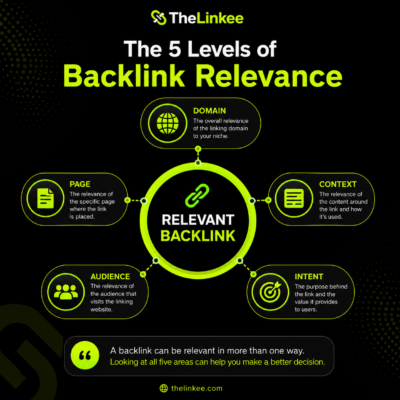
To make backlink relevance easier to understand, look at these five levels.
1. Domain Relevance
Domain relevance looks at the overall subject of a website.
Imagine that you run an SEO company.
These websites could be broadly relevant to your work:
- SEO blogs
- Digital marketing publications
- Content marketing websites
- SaaS marketing blogs
- Websites for business owners and marketers
Because these websites regularly cover related topics, a link between them and your content may make sense.
But domain relevance alone is not enough.
You also need to look at the specific page.
2. Page Relevance
The exact page linking to you matters.
Imagine an SEO website with hundreds of articles.
One article is about:
How to Build High-Quality Backlinks
Another article is about:
The Best Office Chairs for Remote Workers
If both pages link to your guide about link building, the first link has a much clearer topical connection.
The overall website may be relevant in both cases.
But the specific page matters too.
A simple rule:
Don’t evaluate only the website. Evaluate the exact page where your link will appear.
This is especially important when buying placements, doing outreach, or reviewing link opportunities.
Before saying yes to a website, open the actual page.
Read the content.
Ask yourself whether your link belongs there.
3. Contextual Relevance
Contextual relevance means looking at the content around the link.
Imagine this sentence:
Before choosing a website for link building, it’s important to evaluate topical relevance, page quality, and whether the placement makes sense for the reader.
A link to an article about relevant backlinks would fit naturally in that sentence.
Now compare it with:
We found this amazing website. Click here!
Both links could technically point to the same page.
But the first example gives the reader a clear reason to visit it.
Google recommends descriptive, concise, and relevant anchor text that helps people and Google understand the page being linked to.
So instead of:
Click here
A more useful link would be something like:
Learn more about how to evaluate backlink relevance.
The words around the link matter too.
A link should feel like a natural part of the conversation.
4. Audience Relevance
This is one of the easiest ways to evaluate a backlink.
Ask yourself:
Would the people reading this page actually care about my content?
For example, imagine an article about email marketing.
Its readers might include:
- Digital marketers
- SaaS founders
- Business owners
- Growth teams
If you have a useful guide about CRM software, that audience may be relevant.
But if your article is about home plumbing, the connection becomes much harder to explain.
A useful backlink can have value beyond SEO.
It can also introduce your content to people who may genuinely benefit from it.
That is why you should not look at backlinks as just a technical signal.
Think about the actual human being reading the page.
Would they have a reason to click?
5. Intent Relevance
Intent relevance asks another useful question:
Does my content solve the next problem the reader has?
Imagine someone is reading an article about:
How to Improve Your SaaS Marketing Strategy
The article starts discussing SEO and mentions that backlinks can be part of a broader strategy.
The author then links to a detailed guide about building backlinks for SaaS companies.
That link makes sense.
The reader is already learning about SaaS marketing.
SEO is connected to that topic.
The backlink guide helps them go deeper.
This can be a useful way to think about opportunities that are not in your exact niche but still have a clear connection.
Relevant Backlinks vs High-Authority Backlinks
This is where many people get confused.
They think they have to choose between:
- A relevant backlink
- A high-authority backlink
But ideally, you want both.
The strongest opportunities can be:
- Relevant
- Credible
- Useful
- Naturally placed
However, real-world link building is not always that simple.
Sometimes you will find a smaller website that is extremely relevant to your industry.
Other times, you may find a large website with a strong third-party metric but only a weak connection to your topic.
Let’s look at some examples.
| Link Opportunity | Relevance | Authority Metric | Initial Assessment |
|---|---|---|---|
| SEO blog linking to an SEO guide | High | Medium | Strong fit |
| Large unrelated website linking to an SEO guide | Low | High | Needs closer review |
| SaaS publication linking to a SaaS guide | High | High | Potentially excellent |
| Small niche expert site linking to a specialist guide | High | Low or Medium | May still be valuable |
The lesson is:
Authority and relevance are not the same thing.
You should consider both.
Ahrefs defines Domain Rating as its own metric for estimating the relative strength of a website’s backlink profile. It is a third-party metric, not Google’s own ranking score. Learn how Ahrefs defines Domain Rating (DR)
So instead of automatically saying:
“This website has DR 70. I need this backlink.”
Ask:
- Is the website relevant?
- Is the page relevant?
- Does the audience fit?
- Is the content useful?
- Does the placement make sense?
Then look at metrics as additional information.
Relevant Backlinks vs Irrelevant Backlinks
Here are some simple examples.
| Your Content | Relevant Link Opportunity | Weak Link Opportunity |
|---|---|---|
| SaaS link-building guide | SaaS marketing article | Celebrity gossip page |
| CRM software guide | Sales automation blog | Gardening website |
| Cybersecurity guide | Data protection publication | Food recipe blog |
| Fitness program | Health and workout website | Car dealership blog |
| SEO guide | Digital marketing resource | Unrelated entertainment page |
Again, this does not mean every link must come from an identical niche.
SEO is connected to digital marketing.
Fitness is connected to nutrition.
SaaS is connected to business, sales, marketing, and technology.
The important question is:
Can you explain why this link belongs here without forcing the answer?
If yes, it may be worth investigating.
How to Tell if a Backlink Is Actually Relevant
Before spending time on outreach or paying for a placement, use this checklist.
Ask yourself:
- Is the website broadly related to my industry?
- Is the specific page related to my topic?
- Does the content around the link make sense?
- Would the audience benefit from clicking?
- Does my content solve a related problem?
- Does the placement look natural?
- Is there a genuine reason for this website to mention my content?
If most answers are yes, you may have found a strong opportunity.
But relevance is not the only thing to check.
You should also consider:
- Content quality
- Website reputation
- Editorial standards
- Placement
- Potential risk
This is where the TheLinkee 5R Framework can help.
TheLinkee 5R Framework for Evaluating Backlinks
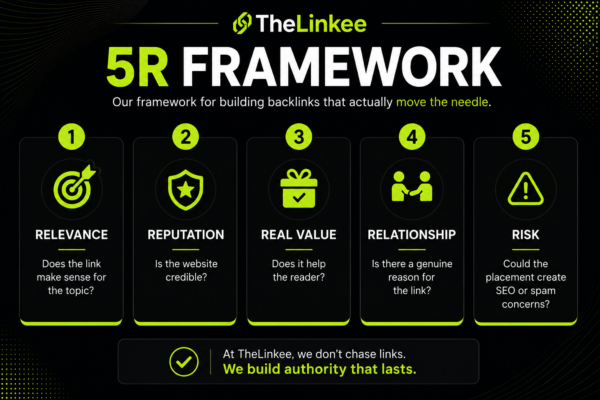
At TheLinkee, we use the 5R Framework to think through potential backlink opportunities.
This is important:
TheLinkee 5R Framework is not a Google ranking formula.
It is simply a practical framework for evaluating whether a link opportunity is worth pursuing.
1. Relevance
Does the link make sense for the topic?
Look at:
- The website
- The specific page
- The surrounding content
- The audience
2. Reputation
Does the website appear credible and well maintained?
Look beyond a single metric.
Consider:
- Content quality
- Editorial standards
- Overall reputation
- Whether the website appears genuinely useful
3. Real Value
Would a real person benefit from this link?
Ask:
- Does it provide useful information?
- Does it help the reader?
- Could it potentially send relevant referral traffic?
4. Relationship
Is there a genuine reason for the website to link to your content?
For example:
- Your research supports their point
- Your guide explains a topic in more detail
- Your tool solves a problem
- Your expertise adds useful information
5. Risk
Could the placement create unnecessary SEO or spam concerns?
Google’s Search Essentials and spam policies explain that spam policies cover tactics that can lead to lower visibility or removal from Google Search. Google also provides specific guidance for qualifying paid and sponsored links. Google’s guidance on qualifying outbound links
The goal is not:
Get every backlink possible.
The goal is:
Build a backlink profile containing links you can reasonably explain and stand behind.
How to Find Relevant Backlink Opportunities
Now let’s get practical.
Finding relevant backlink opportunities becomes much easier when you stop searching only for:
High DR websites
And start with:
What websites and pages are already talking about topics connected to my content?
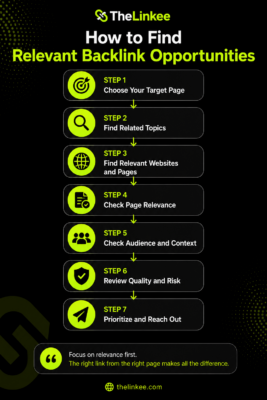
Step 1: Choose the Page You Want to Promote
Start with a specific page.
For example:
Target page:
Relevant Backlinks Guide
Topic:
Backlink relevance
Audience:
- SEO professionals
- Website owners
- Digital marketers
- SaaS companies
Now you know exactly what type of content you are promoting.
Step 2: Build a List of Related Topics
For an article about relevant backlinks, related topics could include:
- Link building
- Backlink quality
- Topical relevance
- SEO authority
- Guest posting
- Digital PR
- Anchor text
- Off-page SEO
- Backlink audits
These related topics can help you discover relevant websites and pages.
Step 3: Search for Relevant Content
Search for articles that already discuss related subjects.
For example:
- link building guide
- backlink quality
- topical relevance SEO
- how to evaluate backlinks
- SEO link-building strategies
You can also use search operators such as:
intitle:"link building" backlinks
or:
"backlink quality" SEO
The goal is not to collect thousands of websites.
The goal is to find specific pages where your content could genuinely add something useful.
Step 4: Open and Read the Actual Page
Don’t stop after looking at the domain.
Open the page.
Read it.
Then ask:
- What is this article about?
- Who is reading it?
- What questions does it answer?
- Is there a section where my content could help?
- Does my article add something the reader does not already have?
This step can save a lot of wasted outreach.
Instead of emailing 1,000 random websites, you can focus on opportunities where there is an actual reason to contact the website owner.
Step 5: Prioritize Your Opportunities
You can create simple categories.
Tier A — Highly Relevant
The website, page, audience, and topic all have a strong connection.
Tier B — Relevant
There is a clear connection, but it may not be perfect.
Tier C — Broadly Related
The audience or industry overlaps, but the page-level connection is weaker.
Tier D — Weak or Unrelated
There is no clear reason for the link.
This does not have to be complicated.
The goal is simply to spend more time on opportunities that make the most sense.
How to Build Relevant Backlinks
There are several ways to build or earn relevant backlinks.
The right approach depends on your industry, content, resources, and goals.
Here are some of the most practical approaches.
1. Create Something Worth Linking To
This is the foundation.
People are more likely to reference content when it gives them something genuinely useful.
Examples include:
- Original research
- Industry statistics
- Free tools
- Templates
- Detailed guides
- Case studies
- Expert insights
- Original frameworks
For example, instead of publishing another generic article called:
10 Link-Building Tips
You could create:
TheLinkee 5R Backlink Evaluation Checklist
That gives writers, marketers, and website owners something specific they may want to reference.
Before promoting any page, ask:
Would I personally link to this if I found it useful?
If the answer is no, improve the content first.
2. Guest Contributions
Writing useful content for relevant publications can introduce you to a new audience.
But the focus should be on contributing something valuable.
Don’t choose a website simply because it has a good DR.
Look for websites where:
- The audience is relevant
- The publication covers related topics
- Your expertise fits
- Your contribution would be useful
A good guest contribution should make sense even before you think about the backlink.
3. Digital PR
Digital PR can involve creating something that journalists, writers, and publishers may find worth mentioning.
Examples include:
- Original research
- Survey results
- Expert opinions
- Industry data
- Interesting trends
- Unique stories
The key idea is simple.
Give people a reason to talk about your work.
If your research provides useful information, another writer may decide to mention and link to it as a source.
4. Broken Link Building
Broken link building starts by finding a page that links to a resource that no longer works.
If you have a genuinely useful replacement, you can contact the website owner and let them know.
The important part is the replacement.
Your page should actually match the original topic.
Don’t contact someone simply because you found a broken link.
Ask:
Can my content genuinely help them fix this problem?
If yes, the opportunity may make sense.
5. Unlinked Brand Mentions
Sometimes a website may mention:
- Your company
- Your research
- Your product
- Your tool
- Your team
But not include a link.
If the mention is relevant, you can politely ask whether linking to the original source would help readers find more information.
This is especially useful when:
- Your original research was mentioned
- Your data was used
- Your company was quoted
- Your product was discussed
6. Resource Pages
Some websites maintain useful resource pages.
For example:
Helpful SEO Resources
or:
Recommended Marketing Guides
If your content genuinely deserves to be included, you can suggest it.
But don’t submit your article to every resource page you find.
Focus on pages where your resource clearly matches the purpose of the list.
Stop Chasing DR Alone
One of the biggest mistakes in link building is using only one filter.
For example:
DR above 50 = good backlink.
That is too simple.
Ahrefs describes DR as a proprietary metric showing the relative strength of a website’s backlink profile, and its own guidance says a website should not be judged on site-wide authority alone. Other factors, including topical relevance and the site’s quality, also matter. Ahrefs’ explanation of Domain Rating
Instead of thinking:
DR 50+ = automatically good
Use a process like this:
Is the page relevant?
        ↓
Does the audience fit?
        ↓
Would the reader benefit?
        ↓
Is there a genuine reason for the link?
        ↓
Does the website meet your quality standards?
        ↓
Review metrics as additional information
        ↓
Make a decision
Metrics can help.
But they should not make every decision for you.
Common Mistakes When Building Relevant Backlinks
Mistake 1: Looking Only at Domain Relevance
A website may be related to your industry.
But the exact page could have nothing to do with your content.
Always look at both:
- The website
- The specific page
Mistake 2: Looking Only at DR or DA
Third-party metrics can be useful.
But they do not tell you everything.
A high number does not automatically mean:
- The audience is relevant
- The page is relevant
- The placement is useful
- The content is high quality
Use metrics as part of your research.
Not as the entire strategy.
Mistake 3: Ignoring the Reader
Ask:
Would a real person reading this page have a reason to click my link?
If there is no clear answer, think carefully about the opportunity.
A good link should have a reason to exist.
Mistake 4: Forcing Anchor Text
Anchor text is the visible text people click.
Google recommends anchor text that is descriptive, reasonably concise, and relevant to the linked page. Google also warns against cramming keywords into anchor text.
Instead of trying to force the exact same keyword every time, use natural language.
For example:
- guide to relevant backlinks
- how to evaluate backlink relevance
- learn more about link quality
- detailed backlink evaluation guide
The goal is clarity.
Not repeating the same keyword everywhere.
Mistake 5: Building Links to Weak Content
Even the best outreach campaign cannot permanently solve a weak content problem.
Before promoting a page, ask:
Is this genuinely worth referencing?
Does it:
- Answer the user’s question?
- Include useful examples?
- Provide something different?
- Make the topic easier to understand?
Google’s Search Essentials recommends creating helpful, reliable, people-first content. Read Google’s Search Essentials
If your content is genuinely useful, it becomes easier to explain why another website should reference it.
How to Audit Your Existing Backlinks for Relevance
You don’t need to panic every time you discover a strange backlink.
Websites cannot completely control who chooses to link to them.
Instead, start with a simple review.
Step 1: Collect Your Backlink Data
You can review backlink information through Google Search Console and other SEO tools.
Look at:
- Websites linking to you
- Important pages receiving links
- New links
- Lost links
Step 2: Look at Your Most Important Links
Start with the links that matter most.
Ask:
- Are they from related websites?
- Are the linking pages relevant?
- Are important pages on my website receiving links?
- Could these links potentially bring relevant visitors?
You do not need to review every single link in one day.
Start with the most important pages and referring domains.
Step 3: Look for Patterns
Ask yourself:
- Are most of my backlinks related to my industry?
- Which pages attract the most relevant links?
- Which important pages have very few links?
- Am I attracting links to useful resources?
- Are there unusual patterns worth investigating?
Patterns can tell you more than simply counting backlinks.
For example, you might discover that your original guides attract more relevant links than your service pages.
That insight can help shape your future content strategy.
Step 4: Don’t Overreact to Every Bad-Looking Link
A low-quality-looking backlink does not automatically mean you need to remove or disavow it.
Before taking action, review Google’s official guidance and understand the situation.
The disavow tool is an advanced feature, and Google recommends using it with care. Read Google’s disavow links guidance
Don’t make decisions based purely on fear.
Look for genuine problems and unusual patterns before taking action.
How Should You Measure Link-Building Success?
Don’t measure success only by saying:
“We built 100 backlinks this month.”
That number alone does not tell you much.
Instead, look at several areas.
Link Growth
Track:
- New relevant referring domains
- Links to important pages
- Lost links
- The types of websites linking to you
SEO Performance
Depending on your goals, you can monitor:
- Organic visibility
- Keyword performance
- Organic traffic
- Performance of pages receiving links
Business Impact
Where possible, also look at:
- Referral traffic
- Leads
- Sign-ups
- Demo requests
- Sales or other conversions
A link-building campaign should support a bigger goal.
More links are not automatically better if they do not help your business move forward.
Relevant Backlinks Take Time
Link building is rarely instant.
You may need time to:
- Create useful content
- Find the right opportunities
- Build relationships
- Send outreach
- Earn placements
- Measure results
There is no fixed number of backlinks that guarantees rankings.
There is also no universal DR score that guarantees success.
SEO is competitive.
Your results can depend on many things, including:
- Search intent
- Content quality
- Competition
- Technical accessibility
- Internal linking
- The usefulness of your page
- Your overall website
Google’s own documentation describes SEO as a combination of practices and systems rather than a single metric or shortcut.
Relevant backlinks should be part of your broader SEO strategy.
They should not be your entire strategy.
TheLinkee’s Simple Rule for Backlink Relevance
If you remember only one thing from this guide, remember this:
A good backlink should have a reason to exist.
Ask yourself:
Why would this website link to us?
Why would the reader click?
Why does this page need our content?
If you can answer those questions clearly, you may have found a strong opportunity.
If your only answer is:
“Because the website has DR 70.”
Then you should probably look deeper.
Frequently Asked Questions About Relevant Backlinks
What are relevant backlinks?
Relevant backlinks are links from websites or pages that have a meaningful connection to your content, topic, or audience. A relevant link should make sense in its surrounding context and give readers a clear reason to visit the linked page.
Are relevant backlinks better than high-authority backlinks?
Not always. Relevance and authority are different things to consider. A strong opportunity may have both. A highly relevant smaller website may also be valuable depending on its audience, content, and placement.
How do I know if a backlink is relevant?
Look at the overall website, the specific linking page, the content surrounding the link, the audience, and whether your content solves a related problem for the reader.
Do backlinks need to come from the same niche?
No. Two websites do not need to be in exactly the same niche to be relevant. Related industries and overlapping audiences can create natural linking opportunities.
For example, SEO, content marketing, SaaS marketing, and digital marketing often overlap.
Should I only build backlinks from high-DR websites?
No. DR is an Ahrefs metric and should not be your only filter. Consider relevance, content quality, audience, reputation, placement, and potential risk as well.
Can an irrelevant backlink still have value?
It may still have value in some situations, such as sending referral traffic or creating brand exposure. However, when evaluating link-building opportunities, it makes sense to prioritize links with a clear and meaningful connection to your content.
How many relevant backlinks do I need?
There is no fixed number. It depends on your competition, website, content, target keywords, and broader SEO strategy.
What is the easiest way to find relevant backlink opportunities?
Start with the page you want to promote. List related topics, find websites and pages discussing those topics, and then evaluate whether your content would genuinely add value.
Final Thoughts
Relevant backlinks are not about finding websites with the biggest numbers.
They are about finding connections that make sense.
The best opportunities usually start with a simple question:
Would this link make the page more useful for the reader?
If the answer is yes, investigate the opportunity.
Look at the page.
Look at the audience.
Look at the context.
Review the website.
Then use SEO metrics as supporting information—not as your entire decision-making process.
A strong backlink profile is not built by chasing every available link.
It is built by earning and selecting links that are relevant, useful, credible, and worth having.
Want to Build a More Relevant Backlink Profile?
Finding backlink opportunities takes more than filtering websites by DR.
At TheLinkee, we focus on finding opportunities that make sense for your topic, content, and audience.
We can help you identify relevant websites, evaluate potential placements, and build a more thoughtful off-page SEO strategy.
Want to Know What’s Holding Back Your Backlink Profile?
Get a free backlink profile review from TheLinkee. We’ll look at your current link profile, identify potential gaps and opportunities, and help you understand where your off-page SEO strategy could improve.
Ready to Build Links That Actually Work?
Join 2,500+ agencies trusting The Linkee.