You’ve created great content, optimized your pages, and fixed your technical SEO—but your competitors are still ranking above you.
One reason could be the websites linking to them.
Link building in SEO is the process of earning links from other websites to your own. These links, commonly called backlinks, can help search engines discover your content, understand connections between topics, and can contribute to your website’s overall authority and visibility.
But here’s the important part: not every backlink is a good backlink.
A link from a relevant, trusted website can be far more valuable than dozens of random links from low-quality or unrelated sites. That’s why modern link building is less about collecting as many backlinks as possible and more about earning links that make sense for your website, your audience, and the page being linked to.
In this guide, we’ll explain what link building is, why backlinks matter, what makes a backlink valuable, how to evaluate link opportunities, which link-building strategies actually make sense, and how to build a stronger backlink profile without wasting money on low-quality links.
We’ll also share TheLinkee’s practical approach to evaluating backlink opportunities, so you can focus on relevance, real value, and quality—not just metrics like DR.
In this guide, you’ll learn:
- What link building is
- What backlinks are
- Why link building matters
- How Google uses links
- What makes a high-quality backlink
- Topical relevance and contextual links
- Dofollow vs. nofollow vs. sponsored vs. UGC links
- Anchor text explained
- The best link-building strategies
- How to build backlinks step by step
- How to evaluate backlink opportunities
- How to audit your backlink profile
- Common link-building mistakes
- Link building and Google’s spam policies
- Whether link building still matters in 2026
- How link building relates to AI Overviews
- How to measure link-building results
1. What Is Link Building?
Link building is the process of getting other websites to link to pages on your website.
A link from another website to yours is called a backlink, also known as an inbound link.
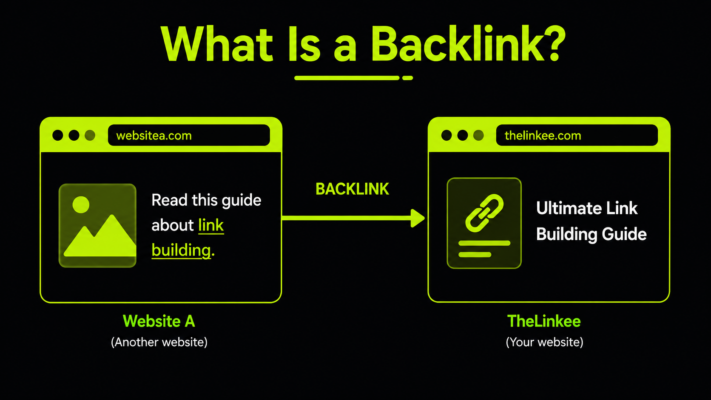
For example, imagine a website publishes an article about SaaS SEO. Within that article, the author recommends one of your guides and links to it.
That link is a backlink to your website.
In simple terms:
Website A → links to → Your Website
That is a backlink.
Link building is generally considered part of off-page SEO because it involves earning or acquiring links from outside your own website. These links can help search engines discover your pages, understand relationships between content, and may contribute to your website’s visibility and reputation.
However, modern link building is not simply a numbers game.
Getting 1,000 random backlinks isn’t necessarily better than earning 20 relevant links from credible websites.
A backlink should ideally make sense in context. The website, the page, the content surrounding the link, and the audience can all affect how valuable that link is.
A better way to think about link building is:
Google explains that crawlable links can help its systems discover new pages and understand the relationship between pages. You can learn more in Google’s documentation on crawlable links.
2. What Is a Backlink?
A backlink is a link from one website to another.
When another website links to a page on your website, that link is a backlink for you.
For example:
A SaaS blog → links to → TheLinkee
TheLinkee receives a backlink from that SaaS blog.
Backlinks are also commonly called:
- Inbound links
- Incoming links
- External links pointing to your website
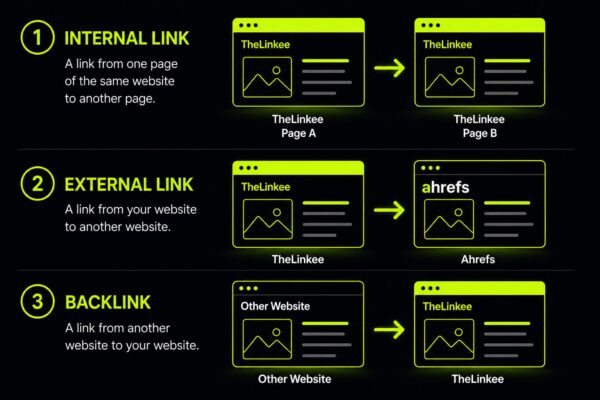
Backlinks vs. Internal Links vs. External Links
These three terms are often confused, especially by beginners.
Internal Link
An internal link connects one page on your website to another page on the same website.
Example:
TheLinkee’s link building guide → links to → another TheLinkee blog post
External Link
An external link points from your website to a different website.
Example:
TheLinkee → links to → another website
Backlink
A backlink points from another website to your website.
Example:
Another website → links to → TheLinkee
The key difference is simply the direction of the link.
- Internal link: Your website → Your website
- External link: Your website → Another website
- Backlink: Another website → Your website
3. Why Is Link Building Important for SEO?
Link building can be valuable for several reasons. A link is not just a connection between two websites—it can help search engines discover pages, understand relationships between content, and bring real visitors to your website.
3.1 Links Help Search Engines Discover Pages
Search engines can use links to discover URLs and navigate between pages.
This is one reason a logical website structure and crawlable links are important.
For example, if another website links to a new page on your site, that link may provide another path for search engines to discover that page.
3.2 Links Can Help Search Engines Understand Relationships
Links can also provide context about the relationship between pages.
Imagine an article about:
“Best Project Management Software”
links to:
“The Ultimate Guide to Project Management”
The connection between these two topics makes sense.
The link provides useful context for both readers and search engines. This is one reason link relevance matters.
A link from a relevant page can be more meaningful than a random link from a completely unrelated topic.
3.3 Links Can Bring Referral Traffic
Backlinks are not only useful for search engines. Real people can click them too.
For example, imagine a popular SaaS blog links to your guide about choosing project management software. Readers interested in that topic may click the link and visit your website.
This is called referral traffic.
A relevant backlink can therefore provide value even beyond its potential SEO impact.
3.4 Links Can Help Build Visibility and Reputation
When relevant and credible websites mention and link to your content, more people may discover your brand.
For example, if an industry publication references your original research, guide, or tool, the link can expose your content to a new audience.
This is why a good link should ideally provide value beyond SEO metrics.
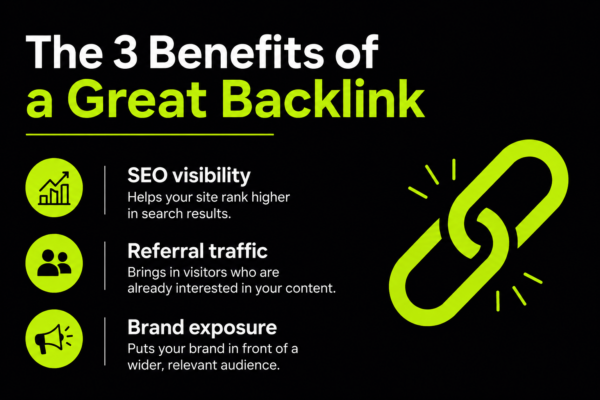
A useful backlink can potentially contribute to:
- Search visibility
- Referral traffic
- Brand awareness
- Content discovery
- Relationships within your industry
However, it’s important to remember that not every backlink has the same value. The relevance of the website and linking page, the context of the link, the quality of the content, and the audience can all matter.
That’s why modern link building is not simply about getting as many links as possible. It’s about earning links that are relevant, useful, and make sense in context.
4. How Does Google Use Links?
Google’s search systems use many signals to understand and rank content.
Links are one part of that larger ecosystem.
Google’s documentation explains that links can help its systems discover pages and understand relationships between pages.
Google’s systems have also historically used links as signals related to relevance and importance.
However, this doesn’t mean:
More backlinks = automatically higher rankings.
Search rankings depend on many factors.
These can include:
- Relevance
- Content quality
- Search intent
- Technical accessibility
- Page experience
- Internal linking
- External references
- Many other signals
This is why building hundreds of backlinks without considering their relevance or quality is not a reliable SEO strategy.
For example, 10 highly relevant backlinks from useful websites may be more valuable than hundreds of unrelated or low-quality links. The goal should not simply be to collect as many links as possible. Instead, focus on earning links that make sense for your content, your audience, and the topic of the page.
For a broader overview of Google’s requirements for search visibility, see Google Search Essentials
If you’re building links as part of an SEO strategy, it’s also important to understand Google’s Spam Policies and avoid practices designed to manipulate search rankings.
5. How Link Building Has Changed
Old-school link building often focused on:
“How many backlinks can I get?”
Modern link building should focus more on:
“Can I earn the right links from the right websites in the right context?”
Today, the focus is less on collecting links and more on earning links that make sense. A useful backlink should come from a relevant website, appear in a natural context, and provide value to the people who may click it. This shift means that link building is no longer simply about increasing backlink numbers—it is about building relevant, trustworthy, and useful connections between websites.
The industry has moved away from many manipulative tactics, including:
- Automated link generation
- Link farms
- Private blog networks
- Mass-produced guest posts
- Excessive exact-match anchors
- Irrelevant paid placements designed solely to manipulate rankings
Google’s spam policies specifically address manipulative link practices.
6. What Makes a High-Quality Backlink?
Not all backlinks are equal.
When evaluating a backlink, look at:
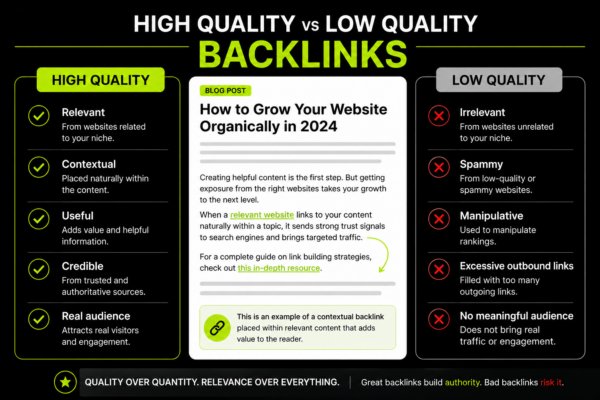
A high-quality backlink is not defined by one metric alone. A website may have a high Domain Rating or strong overall authority, but that does not automatically make every link from it valuable. The strongest opportunities usually combine relevance, useful context, genuine editorial value, a real audience, and low risk.
1. Relevance
Is the website or page related to your topic?
2. Context
Does the link naturally fit into the surrounding content?
3. Editorial value
Was the link included because it genuinely adds value?
4. Website quality
Does the website publish useful and trustworthy content?
5. Organic visibility
Does the website have real search visibility and audience?
6. Link placement
Is the link naturally placed within relevant content?
7. Audience relevance
Could the site’s audience actually be interested in your website?
8. Risk
Does the site show obvious signs of manipulation or spam?
7. Topical Relevance: Does the Website Match Your Niche?
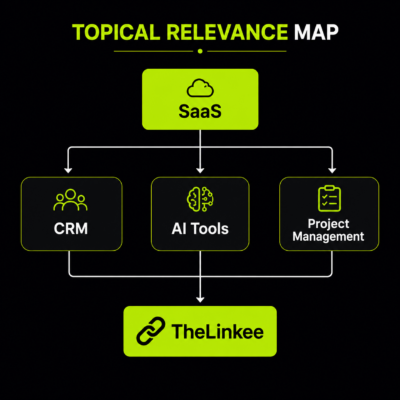
One of the most important things to consider is relevance.
Imagine you sell project management software.
A link from an article about:
Best Project Management Software
is highly relevant.
A link from:
Best SaaS Tools for Remote Teams
could also be relevant.
A link from:
Best Dog Food Brands
is probably not relevant.
This doesn’t mean every backlink must come from an identical niche.
A business publication can naturally link to a SaaS company.
A technology website can link to a CRM.
A startup publication can link to an AI tool.
The key question is:
Does the relationship between the linking page, the link context, and the destination page make sense?
It is also important to look beyond the overall website and evaluate the specific page containing the link. A technology website may be relevant to a SaaS business, but that does not mean every page on that website is a good place for a backlink. For example, a SaaS company would generally have a stronger contextual connection from a page about software, productivity, or business technology than from an unrelated entertainment or lifestyle page.
8. Domain Rating, Domain Authority & SEO Metrics
You will often hear SEOs talk about:
- DR
- DA
- Authority Score
- UR
- Organic Traffic
These metrics can be useful for evaluating websites.
But there is an important distinction:
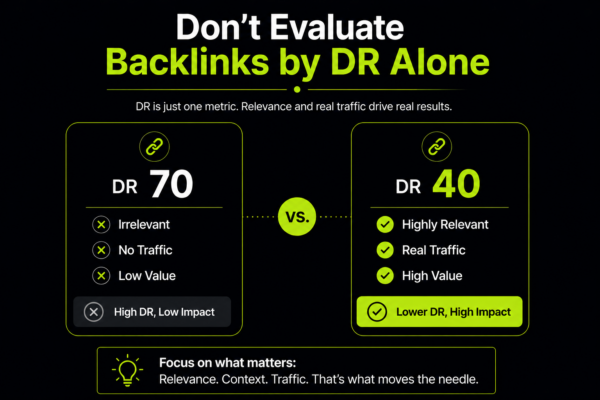
DR and DA are third-party metrics. They are not Google ranking factors.
For example:
A website with DR 70 isn’t automatically a better link than a DR 40 website.
For example, imagine a DR 70 website with very little relevant organic traffic and a large number of unrelated outbound links. Now compare it with a DR 40 website that attracts thousands of visitors from your target industry, publishes relevant content, and places links naturally within its articles. The DR 40 website may be the stronger opportunity because the relevance, audience, traffic, and context make more sense.
You should also consider:
- Relevance
- Organic traffic
- Content quality
- Audience
- Editorial standards
- Link placement
- Website reputation
9. Dofollow vs Nofollow vs Sponsored vs UGC
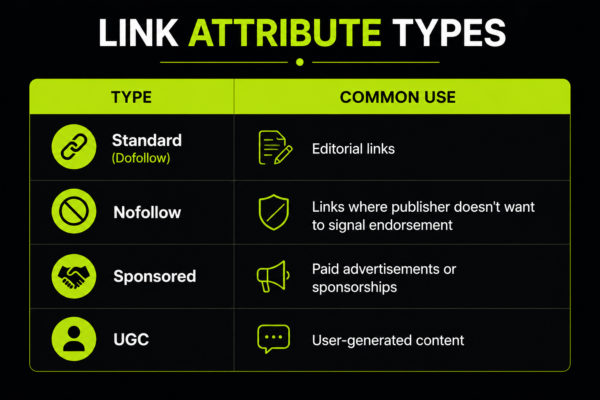
Dofollow / Standard Link
Most ordinary links don’t include a special rel attribute.
A standard link can pass signals that search engines may use when understanding the relationship between pages. However, the rel attribute can tell search engines more about the nature of a link, especially when the link is sponsored, user-generated, or not intended to represent a typical editorial relationship.
Nofollow
Used to indicate that the publisher doesn’t want to endorse or associate the link in the same way as a normal editorial link.
Sponsored
Used for paid or sponsored links.
UGC
Used for user-generated content, such as links posted by users in forums or comments.
10. What Is Anchor Text?
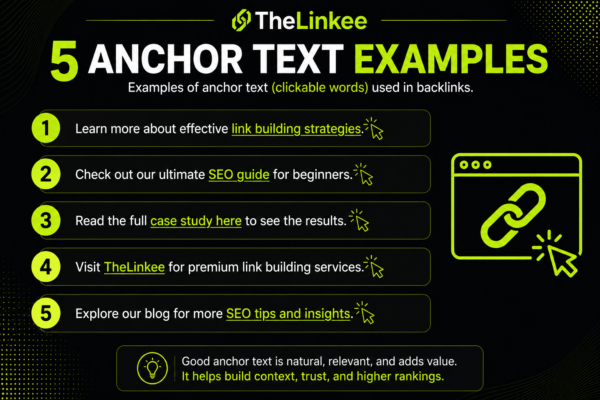
Anchor text is the clickable text in a hyperlink.
Example:
Learn more about SaaS link building
“SaaS link building” is the anchor text.
Common types include:
- Branded
- Naked URL
- Exact match
- Partial match
- Generic
- Descriptive
The key is natural variation.
Anchor text should also make sense in the context of the page being linked to. For example, a page about SaaS link building might naturally receive links using phrases such as “SaaS link building,” “link building for SaaS,” “link building strategies,” or the brand name. The goal is to describe the destination naturally rather than repeatedly optimizing every link around the same keyword.
Don’t force the exact same commercial keyword into every backlink.
11. The Best Link-Building Strategies in 2026
The best strategy depends on your website, industry, resources, and the type of links you want to earn. Some methods work by creating something people naturally want to reference, while others involve finding existing opportunities and building relationships with relevant publishers. The goal is not to use every strategy at once, but to choose the approaches that are most likely to earn relevant and useful links for your website.
11.1 Digital PR
Create something newsworthy.
Examples:
- Original research
- Surveys
- Data studies
- Industry reports
- Expert commentary
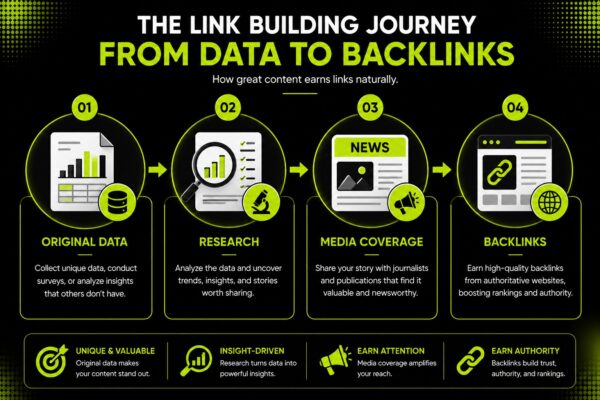
11.2 Data-Driven Link Building
Publish original data.
Example:
“We analyzed 10,000 SaaS websites and found…”
Other websites may reference your findings.
11.3 Linkable Assets
Create content worth referencing.
Examples:
- Statistics pages
- Free tools
- Templates
- Calculators
- Original research
- Industry reports
11.4 Guest Posting
Guest posting can be useful when the website is legitimate, relevant, and the content is genuinely valuable.
But don’t mass-produce low-quality guest posts simply to manipulate rankings.
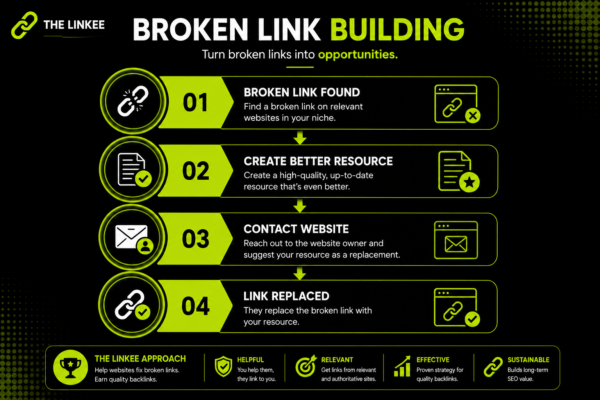
11.5 Broken Link Building
Find broken links on relevant websites.
Create a suitable replacement.
Contact the website owner.
11.6 Competitor Backlink Analysis
Use tools such as:
- Ahrefs
- Semrush
- Moz
Find:
- Link gaps
- Industry publications
- Resource pages
- Unlinked mentions
- Content opportunities
But remember:
Don’t blindly copy every backlink your competitors have.
11.7 Unlinked Brand Mentions
Find websites mentioning your company without linking.
Contact them and ask if they’d consider linking to your relevant page.
11.8 Relationship-Based Link Building
Build relationships through:
- Podcasts
- Partnerships
- Expert interviews
- Industry communities
- Events
- Collaborations
This is one of the most sustainable approaches because you’re building relationships, not just links.
A strong link-building campaign usually combines several approaches rather than relying on one tactic. For example, original research can attract natural mentions, competitor analysis can reveal existing opportunities, and relationships can create future collaboration opportunities. Over time, the best results usually come from consistently creating useful resources and building genuine connections within your industry.
12. How to Build Backlinks Step by Step
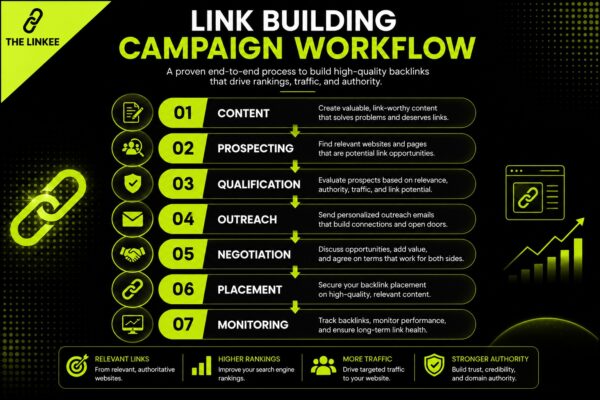
Building backlinks is not simply about finding websites and asking them to link to you. A successful link-building campaign starts with creating something worth referencing, finding relevant opportunities, evaluating those opportunities carefully, and reaching out with a genuine reason for the link.
Here is a practical 7-step process you can follow.
Step 1: Create Something Worth Linking To
Before asking other websites for a backlink, make sure you have something useful to link to.
This could be:
- An original research study
- A detailed guide
- Industry statistics
- A free tool or calculator
- A useful template
- An original report
- A resource that solves a specific problem
For example, if you run a project management software company, a detailed guide comparing project management methods or an original study about how teams use project management tools could give other websites a genuine reason to reference your content.
The stronger the resource, the easier it becomes to explain why someone should link to it.
Step 2: Define Your Ideal Link
Not every backlink opportunity is worth pursuing.
Before searching for prospects, define what a good backlink looks like for your website.
Consider factors such as:
- Topical relevance
- Page-level relevance
- Organic visibility
- Content quality
- Relevant audience
- Editorial standards
- Link placement
- Potential risk
For example, a SaaS company might prioritize a relevant technology or business website with real organic traffic and an audience interested in software rather than simply choosing the website with the highest DR.
This gives you a clear standard for evaluating opportunities instead of chasing metrics blindly.
Step 3: Find Relevant Prospects
Once you know what you are looking for, start finding websites and pages that could naturally reference your content.
You can find opportunities through:
- Competitor backlink analysis
- Google searches
- Industry publications
- Resource pages
- Relevant blogs
- Unlinked brand mentions
- Broken link opportunities
- Existing industry relationships
Look for websites where your content would genuinely make sense.
For example, if you have published a guide about SaaS link building, a relevant SEO publication or SaaS marketing website may be a much stronger prospect than a high-authority website covering an unrelated topic.
Step 4: Vet the Websites
Finding a relevant website is only the beginning. Before contacting the site owner, evaluate whether the opportunity is actually worth pursuing.
Check:
- Is the website relevant to your niche?
- Does it have real organic visibility?
- Is the content useful and well maintained?
- Does it appear to have a genuine audience?
- Are important pages indexed?
- Does the site publish excessive sponsored or guest-post content?
- Does it contain obvious spam signals?
- Are links placed naturally within useful content?
- Does the website have excessive or suspicious outbound links?
Don’t reject or accept a website based on one metric alone.
A DR 40 website with strong relevance, real traffic, and a relevant audience can be a better opportunity than a DR 70 website with little relevant visibility and obvious signs of link manipulation.
Step 5: Find the Right Contact
Once you have identified a good prospect, find the person most likely to handle content or editorial decisions.
Depending on the website, this could be:
- The website owner
- Editor
- Content manager
- Marketing manager
- Author
- SEO manager
Avoid sending the same generic message to every contact.
A relevant person is more likely to understand why your content could be useful to their audience.
Step 6: Send Personalized Outreach
Your outreach should explain why you are contacting that specific person and why your resource could be useful.
Instead of sending:
“Hi, please give me a backlink to my website.”
Explain the connection between their content and yours.
For example:
“I noticed your guide about SaaS marketing mentions link-building strategies. We recently published a detailed guide covering how SaaS companies can evaluate backlink opportunities. It may be useful as an additional resource for your readers.”
The goal is not to pressure someone into adding a link. The goal is to give them a genuine reason to consider your resource.
Personalized outreach does not mean writing a completely different email for every prospect. It means understanding the website, finding a relevant reason to contact them, and avoiding mass-produced messages that have nothing to do with their content.
Step 7: Track Results
Link building becomes much easier to improve when you track what happens.
Keep records of:
- Prospect website
- Contact person
- Outreach date
- Response
- Placement status
- Linking page
- Target page
- Anchor text
- Link type
- Date acquired
- Lost links
You can also track broader campaign metrics such as:
- Outreach sent
- Response rate
- Positive responses
- Links acquired
- Placement rate
- Referral traffic
- Lost links
Over time, this data can show you which types of websites, content, and outreach approaches are producing the best opportunities.
The Goal of the Process
The goal is not to collect the largest possible number of backlinks.
The goal is to consistently earn relevant, useful, and trustworthy links from websites where the connection makes sense.
A smaller number of strong opportunities can be more valuable than a large number of unrelated or low-quality links.
13. How to Evaluate a Website Before Getting a Backlink
Finding a potential backlink opportunity is only the first step. Before accepting or pursuing a link, you should evaluate the website carefully.
A website can have a high DR, DA, or large-looking traffic number and still be a poor backlink opportunity. The goal is to look at the complete picture and understand whether the website is relevant, trustworthy, useful to its audience, and safe to associate with.
TheLinkee Link Quality Checklist
| Factor | Question |
|---|---|
| Relevance | Is the site relevant to your industry or topic? |
| Traffic | Does it have genuine organic search visibility? |
| Content | Is the content useful, original, and well maintained? |
| Authority | Does the website have a credible reputation? |
| Indexation | Are its important pages indexed in search engines? |
| Editorial quality | Does it publish useful content with reasonable editorial standards? |
| Outbound links | Does the website link excessively or show suspicious linking patterns? |
| Placement | Can the backlink be placed naturally within relevant content? |
| Audience | Is the website’s audience relevant to your business? |
| Risk | Does the website show obvious signs of spam or manipulation? |
Don’t Judge a Website by One Metric
No single metric can tell you whether a backlink is valuable.
For example, a website with DR 70 may have very little relevant organic traffic, publish large amounts of unrelated sponsored content, and contain hundreds of commercial outbound links.
Another website may have DR 40, but attract real visitors from your target industry, publish high-quality content, and offer a naturally relevant placement.
The second website could be the stronger opportunity.
This is why DR, DA, traffic, and other third-party metrics should be treated as evaluation tools—not as the final decision.
Look at the Linking Page, Not Just the Website
Website-level relevance is important, but the specific page containing your backlink matters too.
For example, a technology website may be relevant to a SaaS company. However, a backlink from its page about CRM software or productivity tools would usually make more contextual sense than a link from an unrelated entertainment article.
Ask yourself:
Would this link make sense to someone actually reading the page?
If the answer is yes, the placement has a stronger contextual reason to exist.
Check for Link Manipulation Signals
Before pursuing an opportunity, look for patterns that suggest the website exists mainly to sell or manipulate links.
Potential warning signs include:
- Large numbers of unrelated guest posts
- Excessive commercial outbound links
- Articles covering completely unrelated topics
- Very low-quality or repetitive content
- Obvious paid-link patterns
- Pages created mainly for publishing links
- Suspicious spikes in content or backlinks
- Little evidence of a genuine audience
One warning sign does not automatically make a website unusable. Evaluate the overall pattern and context before making a decision.
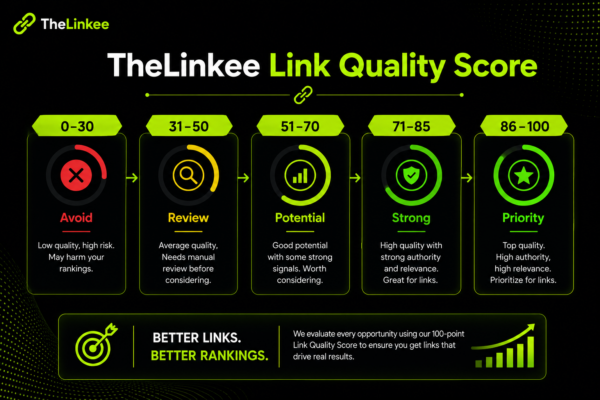
A Simple Decision Framework
After reviewing the website, you can place the opportunity into one of three categories:
Strong opportunity
Relevant website + relevant page + genuine audience + useful content + natural placement + low risk.
Needs review
Some positive signals, but there are questions about traffic, relevance, editorial quality, or link patterns.
Reject
Poor relevance + obvious manipulation + weak content + suspicious linking patterns.
The goal is not to find websites with perfect metrics. The goal is to find websites where the backlink makes real sense for both the reader and the website.
14. How Many Backlinks Do You Need?
There is no universal number of backlinks that every website needs to rank.
You don’t automatically need:
100 backlinks.
Or:
1,000 backlinks.
The number and type of backlinks you may need depend on factors such as:
- Competition
- Search intent
- Existing website authority
- Content quality
- Competitor backlink profiles
- Industry
- Topical relevance
Instead of focusing on a specific number, look at the pages already ranking for your target topic.
Compare things such as:
- Relevant referring domains
- Quality of those referring websites
- Page-level relevance
- Content quality
- Website authority
- Search intent
For example, if the top-ranking pages have hundreds of relevant referring domains, competing with them may require more authority than a less competitive search result. But you should not blindly try to match their backlink count.
The goal is not to copy a competitor’s number of backlinks. The goal is to understand what level of relevance, authority, and content quality the search results require.
Instead of asking:
“How many backlinks do I need?”
Ask:
“What does it take to become one of the most relevant and authoritative results for this topic?”
15. How to Audit Your Backlink Profile
A backlink audit helps you understand the websites linking to your site, the quality and relevance of those links, and where you may have opportunities to improve your backlink profile.
A backlink audit can help you understand:
- Who links to you?
- Which pages attract links?
- Which links have been lost?
- Which competitors have better links?
- Where are your link gaps?
- Are there suspicious or irrelevant linking patterns?
Backlink Audit Process
1. Export Your Backlinks
Use a backlink analysis tool to collect the websites and pages currently linking to your site.
Record useful information such as the referring domain, linking page, target page, anchor text, and link type.
2. Review Referring Domains
Look at the websites linking to you rather than focusing only on the total number of backlinks.
Check whether these websites are relevant, credible, and showing genuine organic visibility.
3. Check Relevance
Review both the referring website and the specific page containing the link.
Ask:
Does this link make sense in the context of the content?
A relevant link from a useful page can be more meaningful than a link from an unrelated website with a higher third-party authority metric.
4. Analyze Link Quality
Review the quality of the websites and placements.
Look for:
- Relevant content
- Genuine organic visibility
- Useful editorial content
- Natural link placement
- Relevant audiences
- Suspicious outbound-link patterns
Don’t judge a backlink using DR, DA, or traffic alone.
5. Identify Lost Links
Find backlinks that previously existed but are no longer active.
Some may have been removed because a page was updated, deleted, redirected, or the website changed its linking structure.
Valuable lost links can sometimes be recovered by contacting the website or finding a suitable replacement opportunity.
6. Compare Competitors
Analyze the backlink profiles of competing websites to discover patterns and opportunities.
Look for:
- Relevant publications
- Industry websites
- Resource pages
- Content opportunities
- Websites linking to several competitors
However, don’t blindly copy every backlink your competitors have. Evaluate each opportunity for relevance and quality before pursuing it.
7. Find Link Opportunities
Use the information from your audit to identify what you should do next.
You may discover opportunities to:
- Recover lost backlinks
- Promote pages that already attract links
- Build relationships with relevant websites
- Create content that fills a link gap
- Pursue relevant websites linking to competitors
The purpose of a backlink audit is not simply to count links or remove anything that looks unfamiliar. It is to understand your backlink profile, identify useful opportunities, and make better link-building decisions.
16. Toxic Backlinks and the Disavow Tool
Don’t panic every time you see a low-quality backlink.
You cannot control every website that links to you, and seeing an unfamiliar or low-quality link does not automatically mean that your website has a problem.
Google’s systems can often identify and ignore spammy or unnatural links. The important thing is to look at the overall backlink profile rather than reacting to individual links.
When Should You Consider Disavowing Links?
The disavow tool is not something every website owner needs to use regularly.
It may be appropriate in situations where you have a significant number of unnatural links that were created specifically to manipulate your site’s rankings, particularly when there is a manual action or other clear reason to address them.
If you’re considering disavowing links, follow Google’s official guidance carefully.
Don’t Disavow Every Bad-Looking Link
A backlink can be low quality, irrelevant, or simply unwanted without requiring you to disavow it.
Before taking action, consider:
- Was the link created by you or someone working on your behalf?
- Is there a clear pattern of unnatural links?
- Is the link actually causing a problem?
- Is there a manual action or other reason to take action?
The goal of a backlink audit is not to achieve a perfectly clean backlink profile. It’s to identify genuine risks and make informed decisions.
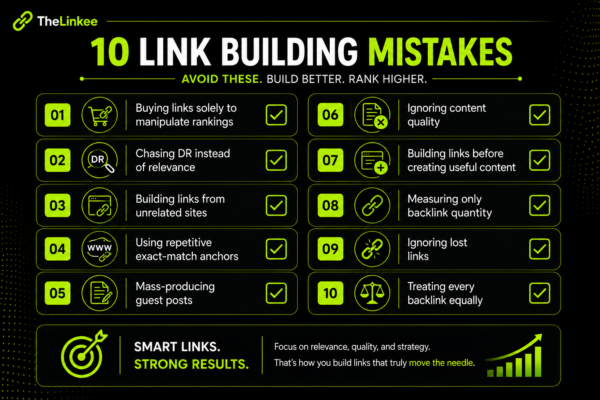
17. Link-Building Mistakes to Avoid
Link building can become ineffective when the focus shifts from earning useful, relevant links to simply increasing backlink numbers. Avoiding common mistakes can help you build a stronger and more sustainable backlink profile.
1. Buying Links Solely to Manipulate Rankings
Paying for a link specifically to pass ranking credit can create risks.
Not every paid link is the same, but links intended primarily to manipulate search rankings can fall under Google’s link spam policies.
2. Chasing DR Instead of Relevance
A high DR does not automatically make a website a good backlink opportunity.
Always consider relevance, organic visibility, content quality, audience, and context alongside third-party metrics.
3. Building Links From Unrelated Websites
A backlink should have a logical connection to your website or the page being linked to.
A relevant link from a smaller website can make more sense than a high-metric link from a completely unrelated site.
4. Using Repetitive Exact-Match Anchors
Using the same commercial keyword as anchor text across many backlinks can look unnatural.
Use anchor text that fits the surrounding content and naturally describes the destination page.
5. Mass-Producing Guest Posts
Guest posting can be useful when the website is relevant and the content genuinely helps its audience.
Publishing large amounts of low-quality content across unrelated websites simply to obtain links is a very different approach and can create unnecessary risk.
6. Ignoring Content Quality
Backlinks cannot compensate for content that does not satisfy the searcher’s needs.
Before investing heavily in link building, make sure the page you are promoting is useful, relevant, and worth recommending.
7. Building Links Before Creating Useful Content
If you don’t have something valuable to reference, outreach becomes much harder.
Create useful guides, research, tools, resources, or other assets that give websites a genuine reason to link to you.
8. Measuring Only Backlink Quantity
A campaign that produces 100 backlinks is not automatically better than one that produces 20 strong, relevant links.
Look beyond quantity and consider:
- Relevant referring domains
- Link quality
- Organic visibility
- Referral traffic
- Target-page performance
- Links gained and lost
9. Ignoring Lost Links
Backlink acquisition isn’t the only part of link building.
If a valuable backlink disappears, investigate why it was lost and whether the opportunity can be recovered.
10. Treating Every Backlink Equally
Not all backlinks provide the same value.
A relevant, contextual link from a credible website can be very different from an irrelevant link placed on a low-quality page.
The goal should not be to collect as many backlinks as possible.
Build links that make sense for your website, your audience, and the content being referenced.
18. Is Link Building Still Important in 2026?
Yes—but the strategy has changed.
Link building is still relevant, but modern SEO is not about collecting as many backlinks as possible. Search engines consider many signals when evaluating and ranking pages, so backlinks should be treated as one part of a broader SEO strategy.
The goal shouldn’t be:
“Get as many links as possible.”
The goal should be:
“Earn relevant references that strengthen your visibility, reputation, and discoverability.”
A useful backlink can do more than contribute to your backlink profile. A relevant link can also put your brand in front of a new audience, send referral traffic, and help connect your content with other resources on the web.
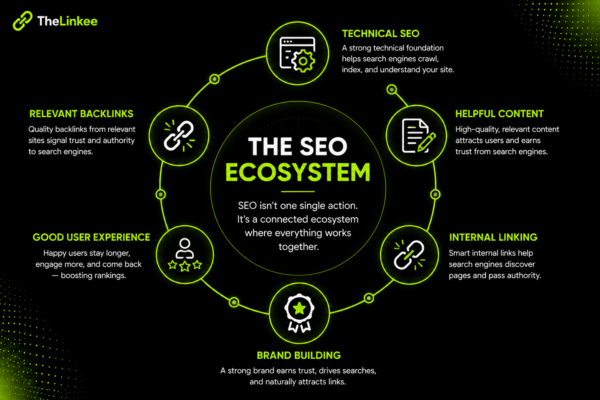
Modern SEO Works as an Ecosystem
Technical SEO
Make your website accessible, crawlable, and technically sound.
Helpful Content
Create content that genuinely satisfies the searcher’s needs.
Internal Linking
Help users and search engines discover related pages across your website.
Relevant Backlinks
Earn links from websites and pages where the connection makes sense.
Brand Building
Build recognition and credibility within your industry.
Good User Experience
Make your website useful, accessible, and easy to navigate.
No single element guarantees rankings. Strong SEO comes from combining these elements rather than relying on backlinks alone.
19. Link Building and Google AI Overviews
As Google Search evolves, many website owners wonder whether backlinks can help their content appear in AI Overviews and other AI-powered search experiences.
Don’t claim:
“Backlinks guarantee AI Overview rankings.”
There is no official evidence that a specific number or type of backlinks guarantees inclusion in AI Overviews.
Google says AI Overviews and AI Mode use the same foundational SEO best practices as regular Google Search.
That means your website should:
- Make content crawlable and accessible
- Create helpful, reliable, people-first content
- Follow Google’s Search Essentials
- Avoid spam and manipulative practices
- Make important information easy for search engines to understand
Backlinks can still be part of a broader SEO strategy because they can help with discovery, relevance, referral traffic, and visibility.
However, there is no specific backlink count that guarantees inclusion in AI Overviews.
The better approach is to focus on the overall quality of your website and content rather than trying to build backlinks specifically to trigger an AI Overview.
20. How to Measure Link-Building Success
Building backlinks is only part of the process. You also need to understand whether those links are contributing to your SEO and business goals.
Don’t measure success by backlink quantity alone.
A campaign that generates 50 irrelevant links may be less valuable than one that earns 10 relevant links that improve visibility and bring qualified visitors.
SEO Metrics
Track changes in:
- Organic traffic
- Keyword rankings
- Referring domains
- Relevant referring domains
- Organic visibility
- Target-page performance
These metrics can help you understand whether your website and target pages are gaining visibility over time.
Link Metrics
Monitor:
- New backlinks
- Lost backlinks
- Link relevance
- Link quality
- Referring-domain quality
- Link placement
- Referral traffic
Don’t just count the number of new links. Look at where they came from and whether they are actually useful.
Referral Traffic
A good backlink doesn’t necessarily need to send thousands of visitors to be valuable.
Even a small amount of highly relevant referral traffic can be useful if those visitors are genuinely interested in your product or service.
For example, a backlink from a niche publication that sends 100 relevant visitors may be more valuable to a SaaS company than a generic website that sends 1,000 visitors with no interest in the product.
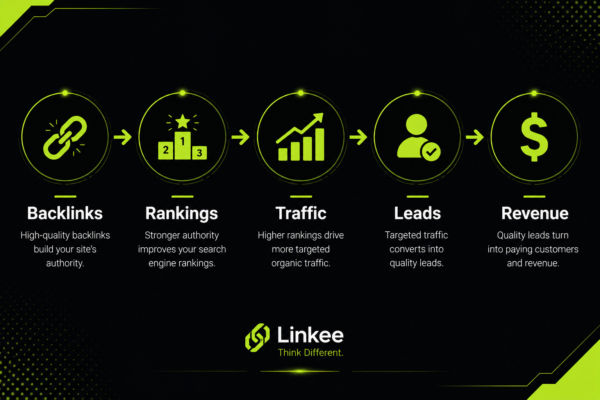
Business Metrics
Ultimately, SEO should support business goals.
Track:
- Leads
- Demo requests
- Sign-ups
- Sales
- Revenue
Where possible, connect referral traffic and organic search performance with actual conversions.
Measure Trends, Not Single Changes
Don’t assume that one new backlink caused every ranking or traffic change.
SEO results can be affected by many factors, including:
- Content updates
- Competition
- Search algorithm changes
- Technical changes
- Internal linking
- Seasonality
- Changes in search demand
Instead, look at performance over time and compare it with the work being done.
The Goal
The goal of link building isn’t simply:
“How many backlinks did we build?”
A better question is:
“Did the links we earned improve our visibility, attract relevant visitors, strengthen our website’s authority, or contribute to business results?”
That’s the difference between measuring link quantity and measuring link-building impact.
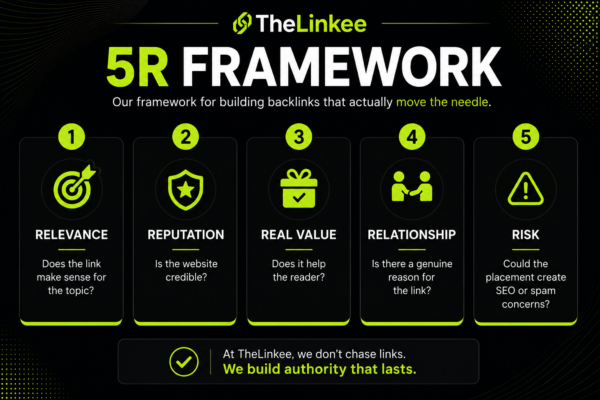
21. TheLinkee 5R Link Quality Framework
Not every backlink opportunity deserves the same level of attention.
To evaluate a backlink more consistently, TheLinkee uses a simple 5R framework:
Relevance → Reputation → Real Value → Relationship → Risk
The framework helps you look beyond metrics such as DR or DA and evaluate whether a backlink actually makes sense.
1. Relevance
Does the link make sense for the topic?
Look at both the website and the specific page where the link would appear.
A link from a SaaS publication to a SaaS-related resource is naturally relevant. A link from an unrelated website simply because it has a high DR is much harder to justify.
Ask:
Would this link make sense to someone reading the page?
2. Reputation
Is the website credible?
Look beyond third-party authority metrics and consider:
- Content quality
- Organic visibility
- Industry reputation
- Editorial standards
- Website history
- Audience
A high DR alone does not prove that a website is trustworthy or valuable.
3. Real Value
Does the link provide genuine value to the reader?
A good backlink should have a reason to exist beyond SEO.
For example, a link that takes readers to a useful guide, research study, calculator, or relevant resource can improve the page by giving readers additional information.
Ask:
If the link had no SEO benefit, would it still be useful to the reader?
If the answer is yes, that’s a strong signal.
4. Relationship
Is there a genuine reason for the link?
Strong link opportunities often come from genuine relationships between websites, businesses, authors, experts, and communities.
These relationships can develop through:
- Expert contributions
- Industry collaborations
- Interviews
- Partnerships
- Podcasts
- Events
- Original research
The goal is to build connections that can naturally lead to useful references over time rather than treating every website as a one-time link opportunity.
5. Risk
Could the placement create SEO or spam concerns?
Look for warning signs such as:
- Irrelevant websites
- Excessive commercial links
- Mass-produced guest posts
- Suspicious outbound-link patterns
- Low-quality content
- Placements created primarily to manipulate rankings
A backlink does not need to be perfect, but obvious manipulation patterns should make you reconsider the opportunity.
How to Use the 5R Framework
Before pursuing a backlink, ask five simple questions:
Relevance: Does it make sense?
Reputation: Can I trust the website?
Real Value: Does it help the reader?
Relationship: Is there a genuine reason for this connection?
Risk: Is there anything that makes this opportunity questionable?
The more confidently you can answer these questions, the stronger the backlink opportunity is likely to be.
The goal isn’t to find the website with the highest DR. It’s to find the link that makes the most sense.
Why This Framework Matters
Metrics such as DR, DA, and traffic can help you evaluate a website, but they don’t tell the entire story.
The 5R framework gives you a broader way to evaluate relevance, quality, usefulness, relationships, and risk together.
That makes it easier to reject attractive-looking opportunities that don’t actually make sense—and prioritize the links that are genuinely worth pursuing.
22. Frequently Asked Questions
What is link building in SEO?
Link building is the process of earning or acquiring links from other websites to your own website. These links can help search engines discover your pages and may contribute to your website’s overall search visibility.
What is a backlink?
A backlink is a link from one website to another. When another website links to a page on your website, that link is considered a backlink.
Why are backlinks important?
Backlinks can help search engines discover content and understand relationships between pages. Relevant, useful backlinks can also generate referral traffic, increase brand exposure, and connect your website with other resources on the web.
How do I build backlinks?
You can build backlinks by creating valuable content, earning editorial mentions, contributing expert insights, using digital PR, publishing original research, and building relationships with relevant websites.
Are backlinks still important in 2026?
Yes. Backlinks remain part of the broader SEO ecosystem, but modern link building is less about collecting large numbers of links and more about earning relevant, useful, and trustworthy references.
How many backlinks do I need?
There is no fixed number of backlinks that every website needs. The right approach depends on your niche, competition, content quality, existing authority, and the backlink profiles of competing pages.
Focus on earning relevant and valuable links rather than chasing a specific number.
What makes a backlink high quality?
A high-quality backlink generally comes from a relevant and credible website, appears naturally within useful content, and provides value to the reader.
Relevance, context, editorial value, and website quality can be more useful indicators than relying on third-party metrics alone.
Are nofollow links valuable?
Yes. Nofollow links can still provide value through referral traffic, brand exposure, and website discovery. Their value should not be judged solely by whether they pass traditional ranking signals.
Is guest posting still effective?
Guest posting can be useful when you contribute genuinely valuable content to relevant publications and build legitimate industry relationships.
It becomes problematic when websites mass-produce low-quality guest posts primarily to manipulate search rankings.
Is buying backlinks safe?
Buying links specifically to manipulate search rankings can create SEO risks and may violate Google’s spam policies.
If a link is part of a legitimate advertising or sponsorship arrangement, follow Google’s guidelines and use the appropriate link attributes where required.
How do I check my backlinks?
You can check your backlink profile using tools such as Google Search Console, Ahrefs, Semrush, and other SEO platforms.
These tools can help you review referring domains, linking pages, anchor text, lost links, and other backlink data.
Should I disavow toxic backlinks?
In most cases, you do not need to disavow backlinks simply because a third-party tool labels them as “toxic.”
Google can often ignore spammy links. The disavow tool is generally intended for specific situations involving significant numbers of artificial or spammy links that could create a problem, particularly when following Google’s guidance for manual actions.
Does link building help AI Overviews?
There is no guaranteed backlink formula for appearing in AI Overviews.
Google says AI Overviews and AI Mode use the same foundational SEO best practices as regular Search. Strong content, crawlability, helpful information, and following Google’s Search Essentials remain important.
Backlinks can be part of your broader SEO strategy, but they should not be treated as a guaranteed way to appear in AI Overviews.
How long does link building take to work?
There is no fixed timeline for link-building results. Some links may be discovered or indexed relatively quickly, while measurable SEO changes can take months.
The timeline depends on factors such as competition, content quality, website authority, indexing, and the overall SEO strategy.
Is a high DR backlink always better?
No. A high DR backlink is not automatically better than a lower-DR backlink.
Consider relevance, organic visibility, content quality, audience, editorial standards, and placement alongside third-party metrics such as DR.
Can backlinks hurt SEO?
Backlinks can create problems when they are part of manipulative or spammy link-building practices.
However, you generally don’t need to worry about every low-quality link pointing to your website. Focus on building a natural backlink profile and follow Google’s spam policies.
Should I build backlinks to my homepage or inner pages?
You can build links to both your homepage and inner pages.
The best target depends on the purpose of the link. If you have a useful guide, research report, product page, or other resource that deserves a reference, linking directly to that relevant page can make more sense than sending every backlink to your homepage.
23. Final Takeaway
Link building isn’t just about numbers.
It’s about relevance, credibility, relationships, and real value.
The strongest link-building strategies don’t focus on collecting the largest number of backlinks. They focus on earning the right links from the right websites in the right context.
A strong link-building strategy starts with useful content, targets relevant opportunities, evaluates websites carefully, and builds genuine relationships instead of chasing metrics alone.
Create something worth referencing.
Build real relationships.
Earn meaningful mentions.
And measure success not just by the number of backlinks you build, but by the impact those links have on your visibility, traffic, leads, and business.
The goal isn’t to build more links. It’s to build better links.
Want to Build a Stronger Backlink Profile?
Not sure whether your current backlinks are actually helping your SEO?
TheLinkee can help you identify valuable link opportunities, evaluate your existing backlink profile, and build a strategy focused on relevant, high-quality links.
Ready to Build Links That Actually Work?
Join 2,500+ agencies trusting The Linkee.